The Barrel of Intelligence: Why Your AI Strategy Needs a Refinery
CyberElders Research · July 2026
Distilled from our position paper The Barrel of Intelligence (Edition 2.0). Subscribers can download the full 34-page paper — complete references, and the objections we argue against ourselves — at the end of this article.
On 14 July 2026, Chamath Palihapitiya gave enterprise AI its most useful unit of account in years. Speaking on CNBC's Squawk Box, he suggested we call one million tokens a barrel of intelligence (a token being the billing unit of model output — roughly three-quarters of a word) and read the price board the way an oil trader would. Around $26 a barrel from OpenAI. $56 from Anthropic's latest. A dollar from Elon, fifty cents from the Chinese labs. Set against WTI crude at roughly $80, his verdict was blunt: “a pricing rationalization has to happen.”
It was a good quip, and it deserved more than a news cycle. We spent the following fortnight taking it seriously, and the conclusion is simple to state. Once you price intelligence like crude, you are obliged to notice something far more important than the price.
Nobody makes money buying crude. The money is made, or lost, in refining it.
A spread no physical commodity could sustain
Start with the market itself. We rebuilt Palihapitiya's price board from the producers' own rate cards rather than his recollection. As of 28 July 2026, a barrel of model output costs anywhere from $0.28 (DeepSeek V4-Flash, an open-weight model released under an MIT licence) to $180 (OpenAI's GPT-5.5-pro). The frontier names sit in between: Claude Fable 5 at $50, GPT-5.6 Sol at $30, Opus 5 at $25. That is a spread of roughly 640-fold across grades. Strip out the quality differences and compare closest comparable grades — a closed frontier model against its nearest open-weight challenger — and a three- to six-fold gap still remains.
Physical commodities simply do not behave this way. Brent and WTI are two benchmark prices for the same molecule, and at their all-time record in 2011 they diverged by about 30% — after which the market spent two years building pipelines to close the gap. A standing 640-fold spread, or even a standing three-fold spread between substitutable grades, is not a curiosity. For a buyer, it is an invitation. Whoever learns to blend grades, meter consumption and switch suppliers captures that spread. Whoever does not, pays it.
The margin nobody measures
Ask a refinery why it exists and you get one number: the crack spread — the margin between the cost of the barrel in and the value of the products out. Crude has no customer value until it becomes petrol, diesel and jet fuel. The refining is the business.
Enterprise AI in 2026 is, we would argue, a refining business that has not yet noticed it is one. The evidence reads both ways precisely because nobody measures the same margin. In mid-2025, more than 80% of enterprises told McKinsey that AI had produced no material earnings impact, and 42% told S&P Global they had abandoned most of their AI initiatives. In the same season, Wharton surveyed the same economy and found three-quarters of enterprises reporting positive returns — whilst MIT's much-quoted “95% of pilots fail” figure was already under methodological fire. The contradiction is the signal. Without a common margin to measure, both camps are partly right and mostly incomparable.
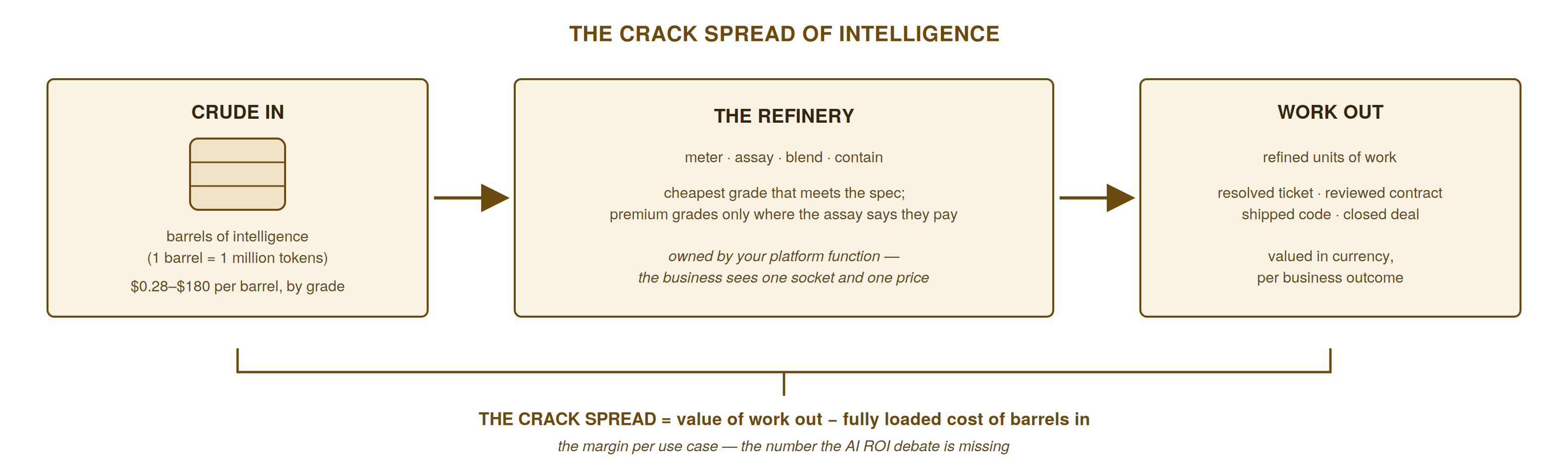
The intelligence crack spread is the margin between what a unit of finished work costs — a resolved ticket, a reviewed contract, a closed deal — and what it returns. Almost no enterprise can state this number today. Only 22% of finance executives say they can connect AI spend to business outcomes at all. It is worth conceding the honest difficulty here: much knowledge work resists clean pricing. The practical answer is to agree value proxies with your finance function once, per use case. Where no defensible proxy exists, measure cost per unit of work against a baseline and say plainly that the value side is being judged rather than measured. A partially measured margin, honestly labelled, still beats the industry standard — which is no margin at all.
How enterprises actually buy intelligence
The buying behaviour would make a petroleum economist wince, and it has three habits worth naming. Firstly, enterprises sign take-or-pay contracts (reserved model capacity, billed whether used or not) without running the utilisation analysis any refinery would demand before committing to a pipeline. Secondly, they default their most expensive grade into workloads nobody has costed — the refining equivalent of making bunker fuel from Brent. Finally, they sink integration effort — customisation, workflow plumbing, staff habits — into a single producer's plant, with very little of it portable.
The switching data confirms how deep the sunk cost runs. In a February 2026 survey of 542 US executives with paid AI contracts, 74% said losing their AI vendor would disrupt daily operations. Two-thirds had attempted a migration between AI platforms, and 58% of those hit failure or unexpected effort. Only 6% believed they could walk away cleanly.
The producers, meanwhile, move on their own schedule — and in both directions. Prices for constant capability fall roughly ten-fold a year. Yet GPT-4.5 was withdrawn five months after launch. OpenAI has more than twenty models scheduled for shutdown on a single date in October 2026, and is winding down its fine-tuning service by January 2027. Anthropic's Sonnet 5 steps up to its predecessor's list price on 1 September, whilst its new tokenizer reportedly emits about a third more tokens for the same text. That last item deserves a moment's pause: it is a repricing not of the rate card but of the unit of account itself. The meter was recalibrated underneath the buyer.
New crude on the market
Concentrated markets loosen the same way every time: new producers outside the incumbent group begin selling comparable product at prices the incumbents cannot ignore. In oil it was the North Sea and the shale patch. In intelligence it is the open-weight producers — models whose weights anyone may download, inspect and run — and 2025–26 was their North Sea moment.
On composite quality indices, the gap between the best open and closed models has narrowed to three points and three to four months. Moonshot's Kimi K3, whose weights were published on 27 July, scores within touching distance of the frontier at a fraction of frontier pricing. DeepSeek's V4 line sells barrels for under a dollar. Even OpenAI now publishes open weights of its own. And, crucially, open weights can be refined on site — run on hardware you own.
South Africans, your author among them, have a name for what that option is worth. When embargoes threatened the country's crude supply, Sasol synthesised fuel from coal — at heavy cost, with decades of subsidy — and the option changed every subsequent negotiation with every external supplier. The open model on your own hardware is the enterprise's Sasol option: supply nobody can embargo, reprice or retire. It does not need to carry your whole load. It needs to exist, be tested, and be scalable — because a buyer with a working alternative is a different buyer.
Build the refinery
The playbook is the one the oil industry wrote after 1973 and refined over fifty years: build the refinery, diversify the crude slate, hold a strategic reserve, meter every custody transfer, and manage the crack spread rather than the barrel price.
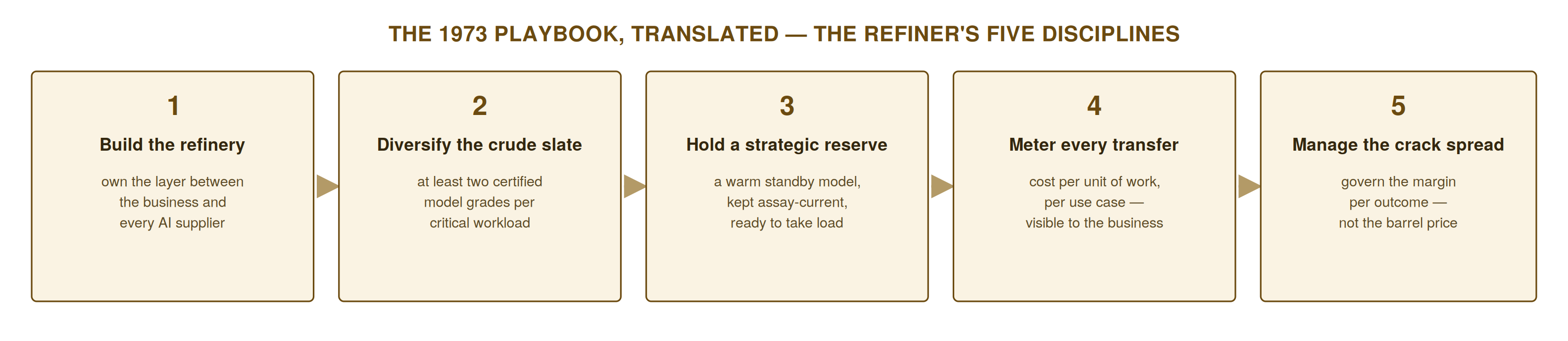
In enterprise terms, the refinery is one piece of company infrastructure, owned by your technology platform function, standing between the business and every AI supplier. Six units make up the plant:
- Custody meters — every request attributed to a use case, team and business unit, with cost reported per unit of work rather than per token.
- Blending and routing — each task sent to the cheapest model that meets its specification. The rule cuts both ways: assay first, then buy the cheapest barrel that meets the spec — which is sometimes the $50 one.
- The assay laboratory — evals (standing quality tests, owned by you) certifying every grade for every workload. The lab is what makes switching safe, and it is arguably the most under-built asset in enterprise AI.
- Safety systems — guardrails, containment and kill-switches enforced at the one point every barrel transits, with review effort proportional to hazard.
- The crude slate and strategic reserve — at least two certified suppliers per critical workload, plus a warm standby kept test-current.
- The trading desk — someone actually working the market: re-benchmarking prices monthly, watching retirement calendars, rehearsing the switch.
Two warnings from hard experience. Firstly, do not build your refinery on the producer's land. The hyperscaler model platforms are excellent supply channels; however, if your meters, assay records and routing policy live inside one incumbent's estate, you have merely rebuilt the dependency one layer up. The point of the refinery is that commoditisation flows from you — suppliers become interchangeable because your lab certifies them and your desk can move the load. Secondly, the refinery comes in sizes. A “topping plant” of pure disciplines — metered spend, two assayed suppliers, an annual exit rehearsal — suits organisations whose AI spend would not yet fund a platform engineer. The full six-unit build earns its keep once intelligence spend is a P&L line and multiple business units consume it. Scale the plant to the throughput; the disciplines are mandatory at every size.
What the board should ask
Boards should govern this the way they govern any refining exposure: a short dashboard, reviewed quarterly, owned by finance rather than by the platform — because the plant cannot be allowed to mark its own margin. Two numbers lead it:
- The crack spread per use case — the value of work out, minus the fully loaded cost of barrels in.
- The tested time to switch supplier — measured in a live drill as a full-stack migration (prompts, harnesses and quality thresholds included), not as endpoint re-pointing.
Behind them sit supplier concentration, reserve readiness, and the share of AI spend the meters can actually see. If neither headline number exists in your organisation today, that is the finding — and the first one costs almost nothing to fix.
There are honest objections to all of this, and the full paper argues the strongest of them against itself. The premium grade genuinely leads where value is highest. Single-vendor buying carries real economics, indemnities and compliance inheritances included. The refinery has running costs of its own. And no independent study yet links multi-sourcing, by itself, to earnings. In our view the rebuttals survive for one reason: whatever the technology does next, an unmetered, single-sourced, unrehearsed AI estate cannot even measure the question.
So do not take our word for it. Run the three cheap experiments instead: meter one workload, assay one second supplier, time one switchover drill. Then let the numbers argue.
The barrel tells you what intelligence costs today. The refinery decides what it costs you tomorrow.
Sources
Selected sources (full grouped and linked references appear in the position paper): CNBC, Palihapitiya on Squawk Box (14 July 2026); producer rate cards fetched 28 July 2026 (OpenAI, Anthropic, Google, xAI, DeepSeek, Moonshot, Z.ai); McKinsey, The State of AI (2025); S&P Global Market Intelligence (2025); Wharton/GBK AI Adoption Report (October 2025); Zapier/Centiment vendor-dependency survey, n=542 (April 2026); OpenAI model deprecations page (fetched 28 July 2026); Epoch AI, open-vs-closed capability gap (May 2026); EIA, Brent–WTI record spread (2011).