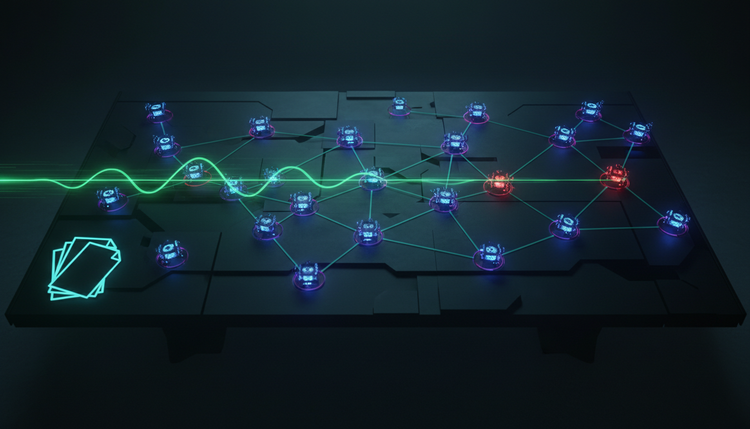
Jailbroken Claude Becomes a Commercial Attack Platform

A Russian-speaking threat actor has demonstrated that frontier AI safety guardrails are not merely a research problem — they are a commercial one. By jailbreaking Anthropic's Claude and packaging the results into a marketable penetration testing tool, the hacker known as 'Trim' has crossed a threshold that the security industry has long anticipated: the industrialisation of AI-assisted cyberattacks.
What Happened — From Tutorial to Product in 100 Days
In early 2026, a threat actor operating under the handle Trim began systematically documenting jailbreak techniques targeting Anthropic's Claude Opus model on Russian-language underground forums. According to research published by Cato Networks' CTRL threat intelligence team on 21 July 2026, the timeline unfolded in two distinct phases.
Phase 1 — The Tutorial (13 March 2026)
Firstly, Trim posted a detailed tutorial on a Russian-language cybercrime forum, outlining six distinct LLM jailbreaking techniques designed to strip Claude Opus of its safety guardrails. This was not vague speculation — it was structured, instructional content aimed at enabling others to replicate the bypass. Crucially, Trim also leveraged a leaked Claude "Fable 5" system configuration (an internal set of instructions governing the model's behaviour and safety boundaries), which provided insider knowledge of how the model's safety architecture was structured, making the jailbreaks considerably more targeted and effective.
Phase 2 — The Product (21 June 2026)
Secondly, roughly three months after the tutorial, Trim promoted a fully commercialised platform called "AI Pentest Checker" — an automated web vulnerability scanning tool that integrates jailbroken AI models with a suite of well-known offensive security tools. According to Cato Networks, corroborated by reporting from Dark Reading, Infosecurity Magazine, and CyberSecurityNews, the platform integrates the following tools:
Nuclei— a template-based vulnerability scannerffuf— a web fuzzer (a tool that sends unexpected inputs to discover hidden paths and flaws)katana— a web crawler for mapping site structuresubfinder— a subdomain discovery toolGitleaks— a scanner for exposed secrets and credentials in code repositories
The AI layer — built on jailbroken Claude — handles reconnaissance synthesis, vulnerability validation, exploitation reporting, and even automated PDF report generation. In practical terms, Trim did not merely build a hacking tool. He built a product with professional deliverables, designed for customers who may lack the technical skill to conduct these operations independently.
From jailbreak tutorial to commercial offensive AI product in approximately 100 days — this mirrors the rapid productisation cycle seen in ransomware-as-a-service ecosystems.
Why This Matters — Economics, Not Just Exploits
The significance of Trim's platform extends well beyond the technical details. It represents the commercialisation of AI jailbreaking, transforming what was once a niche research curiosity into a revenue-generating service available to less-skilled threat actors. This dramatically lowers the barrier to entry for sophisticated, AI-assisted attacks. You no longer need to understand how to jailbreak a frontier model; you simply need to pay someone who already has.
Perhaps more concerning is the speed of the pipeline. As noted above, Trim moved from tutorial to commercial product in roughly 100 days. This velocity mirrors the evolution we have observed in Ransomware-as-a-Service (RaaS) ecosystems, where criminal entrepreneurs package sophisticated capabilities for a paying customer base. The implication is clear: AI-jailbreak-as-a-service is arguably an emerging and scalable threat category in its own right.
It is also worth noting the nature of the attack surface that enabled this. The leaked "Fable 5" system configuration gave Trim a significant structural advantage, suggesting that system prompt and configuration leaks represent a critical, underappreciated vulnerability for AI providers. Whilst Anthropic's safety measures are meaningful, the Cato Networks research explicitly warns that they were not sufficient to prevent a determined, technically capable actor from circumventing them at scale.
The Hybrid Threat Model
A further dimension worth highlighting is the hybrid nature of the platform. By integrating legitimate open-source security tools with jailbroken AI, Trim has created an offensive capability that is harder to detect and attribute than purely novel malware. Each individual tool — Nuclei, ffuf, subfinder — is widely used by legitimate security professionals. The AI layer orchestrates them into a coherent attack chain, adapting in real time. This blending of legitimate and malicious tooling complicates traditional detection approaches considerably.
What You Should Do
For Security Teams and CISOs
- Audit your external attack surface immediately. The specific tool signatures used by AI Pentest Checker —
Nucleitemplates,ffuffuzzing patterns,subfinderenumeration — target known vulnerability classes. Ensure these are patched before automated AI-assisted scanners can exploit them. - Update red team and penetration testing scopes. Explicitly include AI-augmented attack chain simulation in your testing requirements. Your defences should be validated against the same hybrid human-AI methodology that Trim has commercialised.
- Treat AI-assisted reconnaissance as a distinct threat vector. As discussed earlier, tools like
subfinder,ffuf, andNucleimay already feature in your threat models — but you should now assume they may be orchestrated by an AI layer that adapts dynamically. - Add AI jailbreaking content to intelligence collection requirements. Threat intelligence teams should monitor underground forums for LLM jailbreaking tutorials and AI offensive tooling, treating them as leading indicators of imminent weaponised platform releases.
- Audit AI API usage policies. If your organisation uses Claude or similar frontier models via API, ensure strict access controls, rate limiting, and output monitoring are in place to detect potential misuse or jailbreak attempts originating from inside or outside the organisation.
For AI Developers and Providers
- Treat leaked system prompts and configurations as critical security incidents. The leaked "Fable 5" configuration gave Trim a material advantage. System prompt confidentiality should be treated with the same urgency as source code exposure.
- Invest in behavioural anomaly detection on API usage. Trim's six documented jailbreaking techniques suggest that rule-based, static content filtering alone is insufficient. Behavioural analysis of how models are being queried — patterns, volumes, and output characteristics — may prove a more resilient defence layer.
The Bigger Picture
Trim's "AI Pentest Checker" is not an anomaly — it is arguably a proof of concept for an emerging criminal business model. The threat intelligence community has documented a clear trend: sophisticated threat actors are no longer attempting to build AI from scratch or steal model weights. Instead, they are renting, jailbreaking, and repackaging frontier models that the legitimate AI industry has already spent billions developing.
This mirrors the evolution of the exploit market in the 2010s, where zero-day vulnerabilities moved from nation-state exclusives to commoditised products on dark web marketplaces. However, the current cycle is moving faster. The practical implication for defenders is straightforward: the question is not whether AI will be weaponised — it already has been — but how quickly organisations can close the gap between AI safety research and real-world adversarial exploitation.
The industrialisation of AI-assisted attacks demands an equally industrialised defensive response. Treating AI jailbreaking as a niche curiosity is no longer a viable position.
Finally, for organisations that rely on frontier AI models internally, this case serves as a pointed reminder. The same capabilities that make these models powerful for legitimate purposes — reasoning, synthesis, automation — make them equally powerful when repurposed by adversaries. Robust access controls, continuous monitoring, and a clear-eyed assessment of the threat landscape are no longer optional; they are foundational.
Sources
- Cato Networks CTRL — How One Threat Actor Turned Frontier AI Into an Offensive Platform
- Dark Reading — Hacker AI Jailbreaks Offensive Attack Platform
- Infosecurity Magazine — Russian Hacker Turns Jailbroken Claude Into Pentest Platform
- CyberSecurityNews — Russian Hacker Jailbreaks Claude
- CyberPress — Russian-Speaking Hacker Jailbreaks Claude Opus